
Citroen C3: Lighting and visibility / Direction indicators
Citroen C3 2016-2026 Owners Manual / Lighting and visibility / Direction indicators
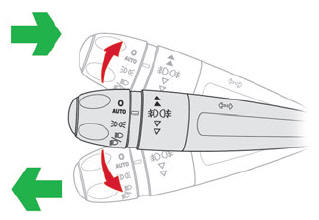
- Left or right: lower or raise the lighting control stalk, beyond the point of resistance.
 If you forget to cancel the
direction
indicators for more than 20 seconds, the
volume of the audible signal will increase if
the speed is above 50 mph (80 km/h).
If you forget to cancel the
direction
indicators for more than 20 seconds, the
volume of the audible signal will increase if
the speed is above 50 mph (80 km/h).
Three flashes
Press briefly upwards or downwards, without going beyond the point of resistance; the direction indicators will flash 3 times.
Parking lamps
Vehicle side marking by illumination of the sidelamps on the traffic side only.
- Depending on version, within one minute of switching off the ignition, operate the lighting control stalk up or down, according to the traffic side (for example, when parking on the left, turn the lighting control stalk upwards; the right-hand sidelamps come on).
This action is confirmed by an audible signal and illumination of the corresponding direction indicator lamp in the instrument panel.
To switch off the parking lamps, return the lighting control stalk to the central position.
 Lighting control
Never look too closely at
the luminous
beam of LED lamps: risk of serious eye
injury!
In some weather conditions
(e.g. low
temperature or humidity), misting on the
internal surface of the glass of the headlamps
and rear lamps is normal, and will disappear
after the lamps have been on for a few
minutes...
 Automatic illumination of headlamps
When the ring is at the “AUTO" position and
a low level of ambient light is detected by the
rain/sunshine sensor, the number plate lamps,
sidelamps and dipped beam headlamps are
switched on automatically, without any action on
the part of the driver...
Other information:
Citroen C3 2016-2026 Owners Manual: Key ignition switch
It has 3 positions: 1. Stop: inserting and removing the key, steering column locked. 2. Ignition: steering column unlocked, ignition on, Diesel preheating, engine running. 3. Starting. Avoid attaching heavy objects to the key or the remote control...
Citroen C3 2016-2026 Owners Manual: Towing
Procedure for having your vehicle towed or for towing another vehicle using the towing eye. General recommendations Observe the legislation in force in the country where you are driving. Ensure that the weight of the towing vehicle is higher than that of the towed vehicle...
Categories
- Manuals Home
- 3rd Generation C3 Owners Manual
- 3rd Generation C3 Service Manual
- Operation
- Energy economy mode
- Android Auto smartphone connection
- New on site
- Most important about car

Copyright © 2026 www.citroenc3.org