
Citroen C3: Access / Central locking
Manual
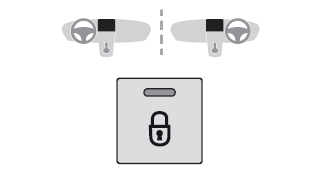
- Press this button to lock/unlock the vehicle (doors and boot) from inside the vehicle.
The indicator lamp comes on to confirm the central locking of the vehicle.
 The central locking does
not take place if
one of the doors is open.
The central locking does
not take place if
one of the doors is open.
 When locking/deadlocking
from the
outside
When locking/deadlocking
from the
outside
When the vehicle is locked or deadlocked from the outside, the indicator lamp flashes and the button is inoperative.
- After normal locking, pull one of the interior door controls to unlock the vehicle.
- After deadlocking, it is necessary to use the remote control, Keyless Entry and Starting or the integral key to unlock the vehicle.
Automatic (anti-intrusion security)
The doors and boot lock automatically while driving (speed above 6 mph (10 km/h)).
To deactivate/reactivate this function (activated by default):
- Press the button until an audible warning is triggered and a confirmation message appears.
 Transporting long or
voluminous
objects
Transporting long or
voluminous
objects
Press the central locking control to drive with the boot open and the doors locked. Otherwise, every time the speed of the vehicle exceeds 6 mph (10 km/h), the locks will rebound and an alert will appear. Pressing the central locking button unlocks the vehicle.
Above 6 mph (10 km/h), this unlocking is temporary.
 Boot
Boot
Opening
With the vehicle unlocked or with the
Keyless Entry and Starting electronic key in
the recognition zone, press the central tailgate
control...
 Alarm
Alarm
(Depending on the country of sale.)
System which protects and provides a deterrent
against theft and break-ins. It provides the
following type of monitoring:
Perimeter monitoring
The system checks the opening of the vehicle...
Other information:
Citroen C3 2016-2026 Owners Manual: Steering mounted control
ON (CRUISE position) / OFF Activation of cruise control at the current speed / decrease speed setting Activation of cruise control at the current speed / increase speed setting Pausing / resumption of cruise control with the speed setting previously stored Use the speed suggested by the Speed Limit Recognition and Recommendation (MEM display) For more information on the Speed Lim..
Citroen C3 2016-2026 Owners Manual: First steps
Example of a "voice command" for navigation: "Navigate to address, 11 Regent Street, London". Example of a "voice command" for the radio and media: "Play artist, Madonna". Example of a "voice command" for the telephone: "Call David Miller". The voice commands, with a choice of 12 languages (English, French, Italian, Spanish, German, Dutch, Portuguese, Polish, Turkish, Russian, Arabic, Br..
Categories
- Manuals Home
- 3rd Generation C3 Owners Manual
- 3rd Generation C3 Service Manual
- Cruise control
- Central locking not functioning
- LCD symbols instrument panel
- New on site
- Most important about car
